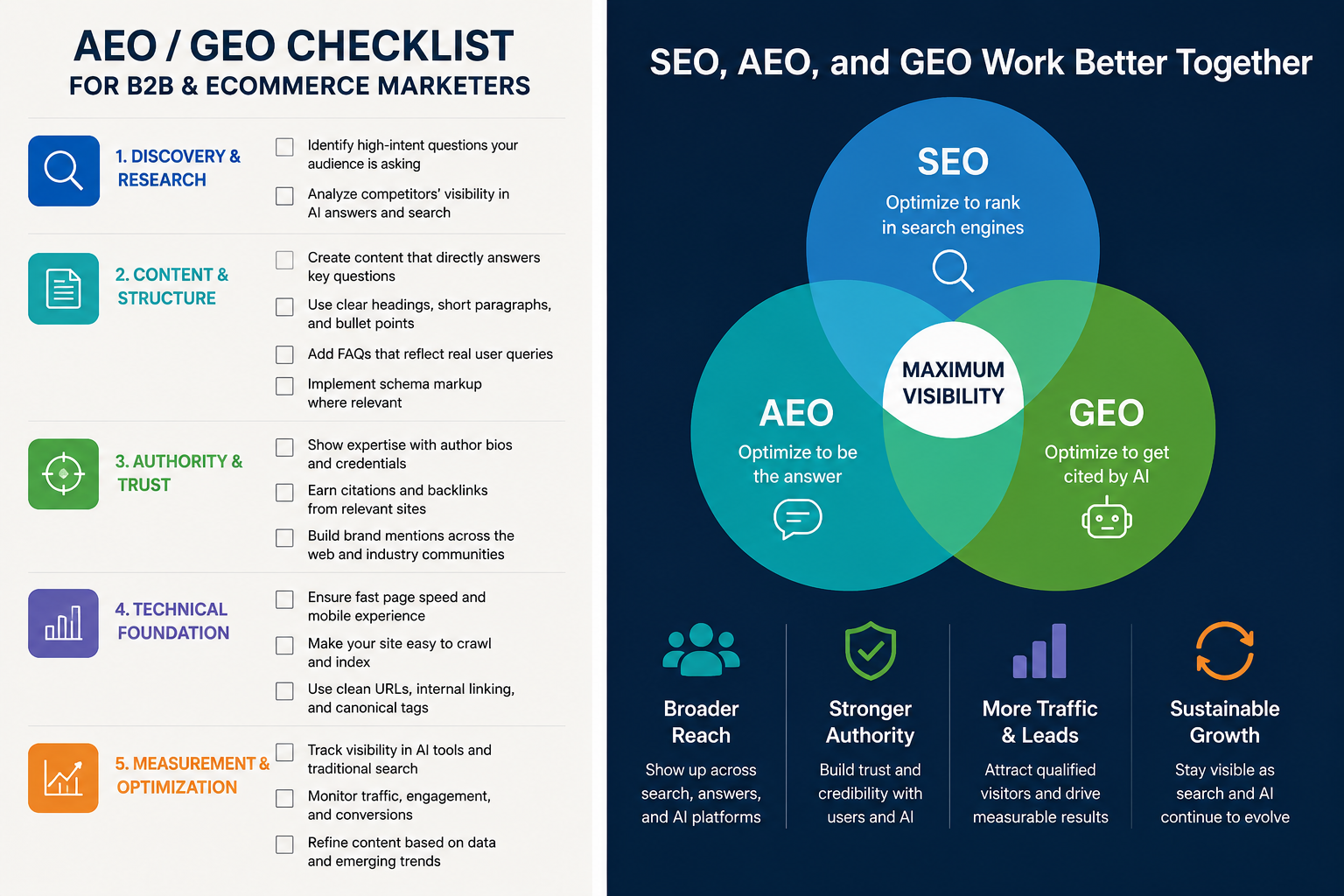
The fastest way to lose AI-search visibility is to publish content that reads fine to a human but is hard for an LLM to quote, verify, or extract. This checklist gives B2B and ecommerce marketing teams a practical, run-it-yourself audit for Answer Engine Optimization (AEO) and Generative Engine Optimization (GEO), so ChatGPT, Gemini, Perplexity, and AI Overviews can find, trust, and cite your content.
This is built for marketing leads, content teams, and operators auditing an existing site, not for teams starting a GEO strategy from zero. Work through each section in order. Each item is written as a pass/fail check so you can run it page by page.
Key facts
AI answer engines reward content that is structured, specific, and independently verifiable, not just well-written.
Most of this checklist reuses SEO fundamentals you likely already have. GEO adds structure, extractability, and proof on top.
Run this audit on your 10-20 highest-intent pages first. Full-site rollouts come after the format is proven.
Section 1: Technical Foundation
AI crawlers need to reach and parse your content before anything else on this list matters.
Confirm AI crawlers are not blocked. Check robots.txt for GPTBot, Google-Extended, PerplexityBot, and ClaudeBot. Blocking them removes you from that engine's training and retrieval entirely.
Serve a static or server-rendered HTML version of key pages. If your content only renders client-side via JavaScript, many retrieval crawlers will see an empty page.
Keep page load fast and stable. Retrieval systems deprioritize pages that time out or serve inconsistent content across requests.
Maintain a clean, current XML sitemap. Submit it in Search Console and Bing Webmaster Tools so both traditional and AI-adjacent crawlers can discover new and updated pages quickly.
Use canonical tags correctly. Duplicate or near-duplicate URLs dilute which version gets cited.
Section 2: Content Structure and Answer-First Writing
This is the highest-leverage section. LLMs extract answers in discrete chunks, so structure determines whether you get quoted.
Open each section with the answer, not the setup. Put the direct answer to the implied question in the first sentence under each heading, then add supporting detail below it.
Write headings as questions or clear claims. "How to Calculate Contribution Margin" outperforms "Understanding Margin" because it maps directly to how people phrase prompts.
Break content into liftable atoms. Numbered steps, short definitions, specs, and FAQ pairs are far easier for a model to extract cleanly than dense paragraphs.
Keep paragraphs short. Aim for 2-4 sentences per paragraph in any section you want quoted.
Use tables for comparisons and data. Tables are some of the most reliably extracted and cited formats across AI search engines.
Add a dedicated FAQ block to high-intent pages. Phrase questions the way a buyer would ask them, and answer each in one to three sentences before adding depth.
Avoid burying the main claim in the conclusion. If your best insight is in paragraph 12, most retrieval systems will never surface it.
Section 3: Structured Data and Machine Readability
Schema markup does not guarantee a citation, but it removes ambiguity about what your content is and who is responsible for it.
Implement Article or BlogPosting schema on every blog post, with author, datePublished, and dateModified populated.
Add FAQPage schema to any page with an FAQ block, matching the visible questions and answers exactly.
Use Organization and Person schema to establish clear entity identity for your brand and named authors.
Add BreadcrumbList schema so engines can understand where a page sits in your site's topical structure.
Validate every schema type with Google's Rich Results Test or Schema.org's validator before publishing.
Section 4: Proof, Authority, and E-E-A-T
AI engines increasingly weight trust signals. Generic claims without evidence are the most common reason otherwise well-structured content fails to get cited.
Attribute posts to a real, named author with a bio and credentials, not "Admin" or a generic byline.
Back claims with specific numbers, not adjectives. "Reduced CAC payback from 5 months to 2.8 months" is citable. "Significantly improved CAC" is not.
Cite your own data or named sources wherever possible. Original data is the single strongest GEO asset, since it cannot be found and quoted from anywhere else.
Keep publish and last-updated dates visible and current. Stale, undated content is systematically deprioritized versus refreshed pages covering the same topic.
Link out to credible third-party sources when citing external claims or statistics.
Section 5: Distribution and Citation Tracking
Publishing well-structured content is necessary but not sufficient. You need visibility into whether it is actually getting used.
Monitor referral traffic from AI platforms in GA4 by segmenting traffic from chatgpt.com, perplexity.ai, gemini.google.com, and copilot.microsoft.com.
Manually test your target prompts in ChatGPT, Gemini, and Perplexity monthly to see whether and how your brand is cited.
Keep a citation log tracking which pages get cited, for which prompts, and by which engine, so you can double down on formats that work.
Repurpose high-performing pages into other formats (a definition into a glossary entry, a checklist into a downloadable tool) to increase the surface area a model can pull from.
How to use this checklist
Start with Section 2. Structure and answer-first writing produce the fastest, most visible improvement, and most of the other sections support it rather than replace it. Run the full checklist against your highest-intent pages first, fix what fails, then expand outward.









.svg)
