




© 2025 Onward. All rights reserved.
Designed by BX Studio


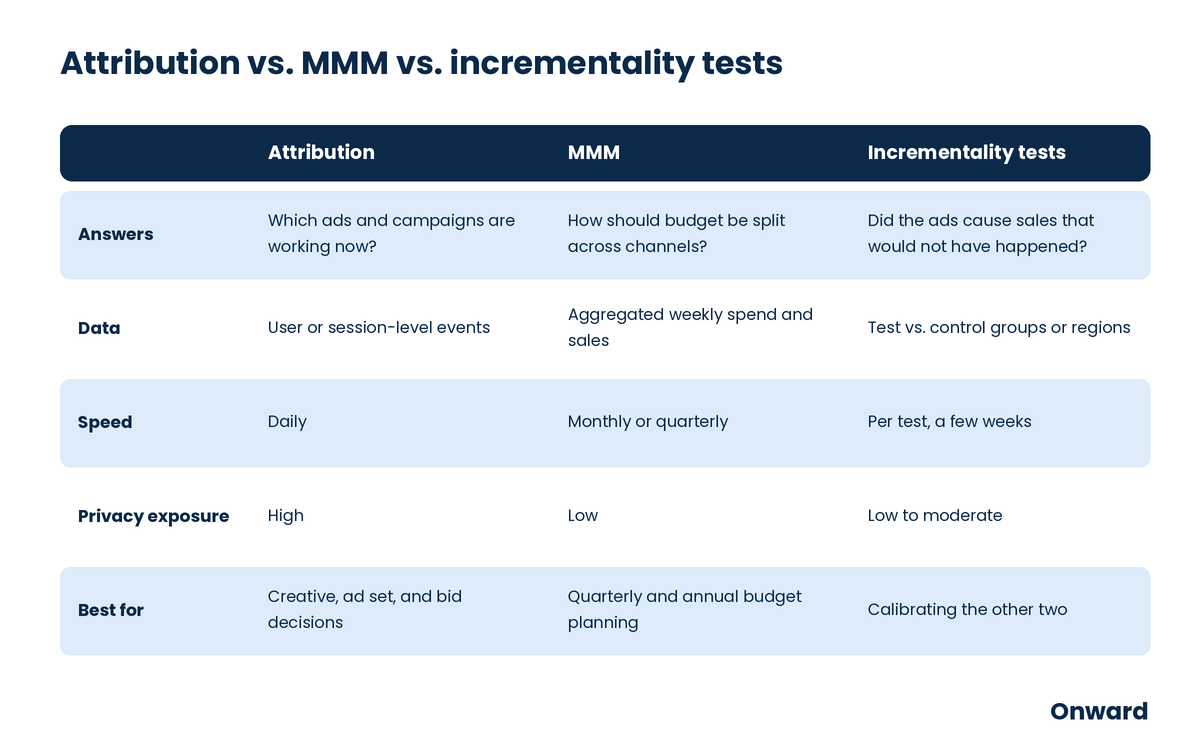
Most growing brands need all three, but not all at once. Attribution guides fast, day-to-day optimization inside channels. Marketing mix modeling (MMM) answers slower, strategic questions about how to split budget across channels. Incrementality testing measures whether a channel actually causes sales, and keeps the other two honest. Which you need first depends on how many channels you run, how much history you have, and which decisions you are trying to make.
Attribution connects ad interactions to conversions at the user or session level. Platform attribution in Meta or Google Ads, and cross-channel tools like GA4, show which campaigns, ad sets, and creatives were present before a purchase. That makes attribution useful for daily and weekly decisions: pausing weak ads, shifting budget between ad sets, or picking winning creative. Teams running paid search and paid social management rely on it every day.
Its weaknesses are well known. Consent requirements, browser restrictions, and cross-device journeys mean many conversions are modeled or missed. Each platform tends to credit itself, so summing platform results overstates the total. And attribution shows correlation along a path, not whether the ad caused the sale. Upper-funnel channels often look weaker than they are, while branded search and retargeting look stronger.
MMM estimates how spend in each channel relates to total sales over time, while accounting for seasonality, promotions, and pricing. Because it works on aggregated data, it does not depend on cookies or user-level tracking. Google describes its open-source Meridian model as privacy-safe for this reason, and Meta's Robyn documentation makes the same point.
MMM is strongest for strategic questions: how much budget each channel should get, where returns start to diminish, and how much revenue comes from baseline demand rather than marketing. Its limits are speed and data. Models are typically refreshed monthly or quarterly, they cannot tell you which ad to pause today, and they need enough history and spend variation to produce reliable estimates. Meta's Robyn guide suggests at least two years of weekly data, and Google's Meridian documentation cautions that two years can still be too little for some model designs.
Incrementality tests compare people or regions that saw ads with similar ones that did not. Geo holdouts, platform lift studies, and simple on/off tests give the most direct read on whether a channel creates sales. They are also the best way to check whether attribution or MMM estimates are in the right range.
The trade-offs are cost and coverage. Each test answers one question for one period, holdouts give up some sales while they run, and small tests can be too noisy to act on. As of November 2026, Google and Meta both offer lift studies, though access typically goes through an account representative and Google lists eligibility requirements on its Conversion Lift help page.
If you spend mainly on one or two channels and have limited history, a full MMM is usually premature. Reconcile platform results with backend orders, track new customers and contribution margin, and run an occasional holdout on your biggest channel. A clean foundation of ecommerce data unification does more for decision quality at this stage than a sophisticated model.
Once spend is spread across Meta, Google, TikTok, Amazon, and possibly offline media, attribution alone starts to mislead budget decisions. Add regular incrementality tests on the largest channels, then MMM once you have the history to support it, calibrated with those test results.
All three methods usually measure revenue. Translate their outputs into contribution margin, because channels can drive similar revenue with very different product mix, discounting, and returns. CM vs. ROAS for media buying covers why the unit of measurement matters as much as the method.
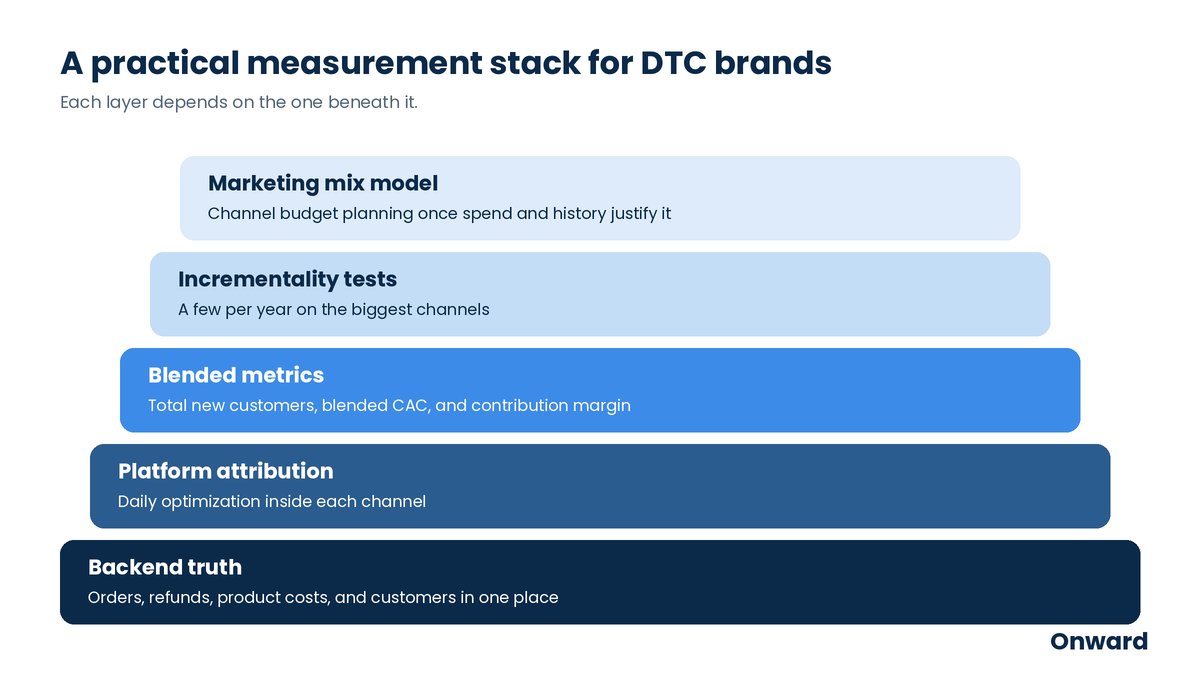
Each layer relies on clean data. That is the work behind engineered analytics: joining spend, orders, customers, and costs so every method works from the same numbers. It is also how Onward approaches unifying fragmented marketing data for clients.
Onward starts with backend reconciliation and contribution margin reporting, uses platform attribution for in-channel optimization, and adds testing and modeling as spend grows. For an example of profit-first scaling, see how 500 LEVEL grew revenue 156%.
There is no fixed threshold, but MMM needs enough spend, channel variety, and history to separate each channel's effect from seasonality and baseline demand. Brands spending mostly on one channel, or with less than about two years of weekly data, usually get more from backend reconciliation and holdout tests first.
Not for day-to-day work. MMM is updated monthly or quarterly at the channel level, so it cannot tell a media buyer which ad set to scale this week. Use it to set channel budgets, and attribution to optimize inside them.
Yes. Models can attribute effects to the wrong channel when spend moves together. Tests give an independent measurement that keeps the model grounded.
Attribution tells you what to adjust this week. MMM tells you how to allocate next quarter. Incrementality tests tell you whether either is right. Start with clean backend data and add each method as your spend and channel mix grow, measuring everything in contribution margin.
If you want help deciding which measurement approach fits your stage, book a discovery call with Onward.