



© 2025 Onward. All rights reserved.
Designed by BX Studio


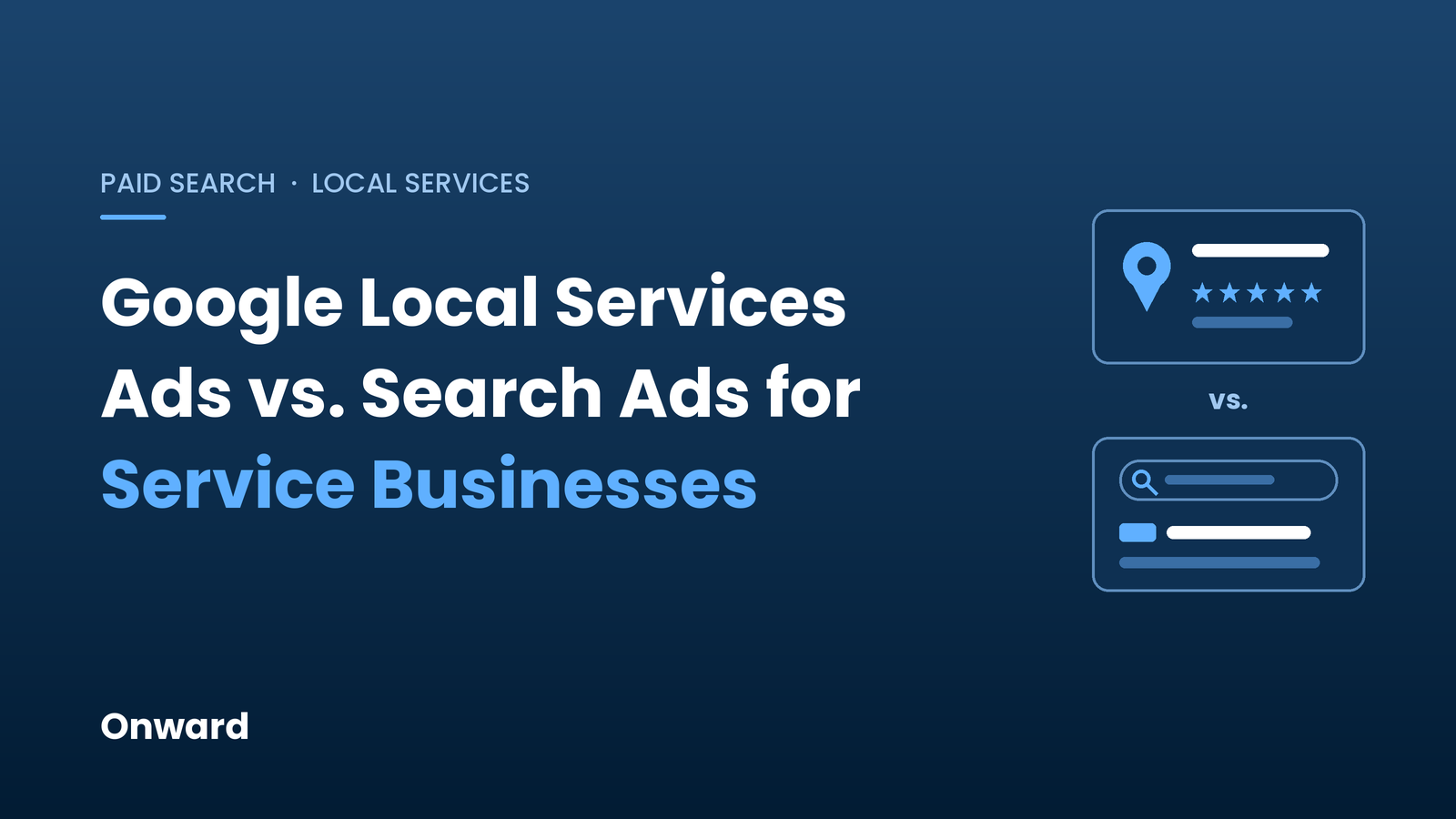
Google Local Services Ads charge per lead and rank businesses mostly on reviews, responsiveness, and verification, while Google Search ads charge per click and give you control over keywords, ad copy, and landing pages. For most service businesses, Local Services Ads are the simpler way to buy phone calls in a defined area, and Search ads are the better tool for controlling which jobs you pay for. Many businesses run both. The right mix depends on which one produces booked jobs at a cost your margins can support.
Local Services Ads are Google's pay-per-lead format for local service providers such as plumbers, HVAC companies, electricians, cleaners, and lawyers. Ads show a business profile with ratings, reviews, and a verification badge, and they appear on Google Search and Google Maps.
Search ads are standard text ads in Google Ads. You choose keywords, write the ads, set bids, and send clicks to your website or a call. They are one part of broader paid search and paid social management, and they work for almost any business type.
As of November 2026, Local Services Ads charge for leads: answered or returned calls, voicemails, messages, and, in the US and Canada, bookings. According to Google's lead charging policy, missed calls during business hours that last more than 20 seconds can also count as leads, and repeat contact from the same customer within 15 days is not charged again. Google may credit leads it later identifies as invalid, but credits are not guaranteed.
Search ads charge when someone clicks. A click might become a call, a form fill, or nothing. That makes cost per click less meaningful on its own. What matters is how many clicks turn into qualified leads, and how many of those leads turn into paid jobs.
Hypothetical example: A plumbing company pays $60 per LSA lead and books 40% of them, so each booked job costs $150 in media. On Search, the same company pays $10 per click, converts 10% of clicks into calls, and books 50% of those calls, which works out to $200 per booked job. If the average job leaves $400 in margin before marketing, both channels are profitable, but LSA is doing it more cheaply. If the Search campaigns are focused on high-value emergency or installation jobs, the comparison can flip.
Search ads offer far more control. You can bid on specific services like "tankless water heater installation," exclude low-value searches like "DIY" or "jobs," write your own offers, schedule ads by hour, and send traffic to landing pages built for each service.
LSA is keywordless. You pick service categories, job types, and service areas, set a budget, and choose a bidding approach. Google matches you to searches. That simplicity saves time, but you cannot steer spend toward your most profitable job types with the same precision.
In Local Services Ads, Google ranks advertisers using their bid, how likely they are to get a lead, and profile quality. Likelihood includes responsiveness, so missed calls hurt. Profile quality includes rating, number of reviews, response time, photos, and completed verification. Google now uses a single "Google Verified" badge, which replaced the older Google Guaranteed and Google Screened badges.
In Search ads, position depends on your bid, the ad's expected click-through rate, ad relevance, and landing page experience. A company with few reviews can still compete on Search with strong ads and pages, which is harder to do in LSA.
Lead quality varies by market, but the bigger issue is whether you can see it. A cheap lead that never books is not cheap. Track every lead from both channels through to the job outcome. For Search, Google Ads supports call tracking and offline conversion imports, so booked jobs from your CRM can be sent back to Google Ads as CRM stages. That lets bidding learn from paid jobs instead of raw calls.

Optimizing for lead volume alone often sends budget in the wrong direction. For Porter, Onward optimized toward qualified studios rather than raw form fills, which produced 77% more qualified leads from creative testing. The same principle applies to service calls.
Often, yes. LSA and Search ads can appear on the same results page, so running both can increase the share of local searches you capture. The risk is paying twice for customers who would have found you anyway, or losing track of which channel actually produced the job.
The fix is shared measurement. Bring LSA leads, Search conversions, call tracking, and CRM job data into unified marketing data, then compare channels on cost per booked job and margin per job. Moving past cost per lead is the same shift described in moving beyond ROAS and CPL.
Google is moving Local Services Ads into Google Ads as Performance Max campaigns with pay-per-lead goals. According to Google's migration guide, the rollout began in August 2026 for some US categories, continues for service-area businesses in late 2026, and extends to other regions and categories in 2027. Targeting stays keywordless, and bidding moves to a campaign-level target cost per lead. Separately, the lead policy now charges for qualifying missed calls, a change advertisers were told would take effect October 1, 2026, which ties answering the phone even more directly to cost.
For advertisers, the practical change is that LSA and Search will be managed in the same account, which makes it easier to compare them, and easier to mistake overlapping results for growth.
Onward runs paid search against backend outcomes, not lead counts. For a service business, that means connecting call tracking and CRM outcomes to each campaign, splitting high-margin services from low-margin ones, and moving budget between LSA and Search based on which produces profitable jobs.
Local Services Ads are the easier way to buy local calls if your reviews and responsiveness are strong. Search ads give you the control to pay for the jobs you actually want. Run the one, or the mix, that produces the lowest cost per profitable job, and measure it with your own job data.
If you want to see how your local campaigns compare on booked jobs, schedule a free audit with Onward.