


© 2025 Onward. All rights reserved.
Designed by BX Studio


To launch a new product with paid media, set a test budget based on how many conversions you need to learn, not on a revenue goal. Run the launch in stages, from early signal to validation to scale, and agree on the numbers that will decide whether to scale, change, or stop before the first ad goes live. Make the final call on cost per new customer and contribution margin once enough conversions have come in, not on the first few days of platform data.
Start with what it costs to get a readable result. A useful launch budget covers enough conversions for each creative concept or audience you plan to test, plus a reserve to scale the winners. Teams that run paid search and paid social management for launches usually split the budget into a fixed learning phase and a conditional scaling phase.
Hypothetical example: A brand is testing four creative concepts for a new product and wants roughly 40 purchases per concept before judging them. It expects a cost per purchase of about $45 during the test. The learning budget is 4 × 40 × $45, or $7,200. The brand then holds another $10,000 in reserve, released only if at least one concept beats the target CPA.
If that budget is more than the business can risk, test fewer concepts rather than spreading spend so thin that no concept gets enough data.
Most launch problems start before the first impression. Before spend begins, confirm the basics:
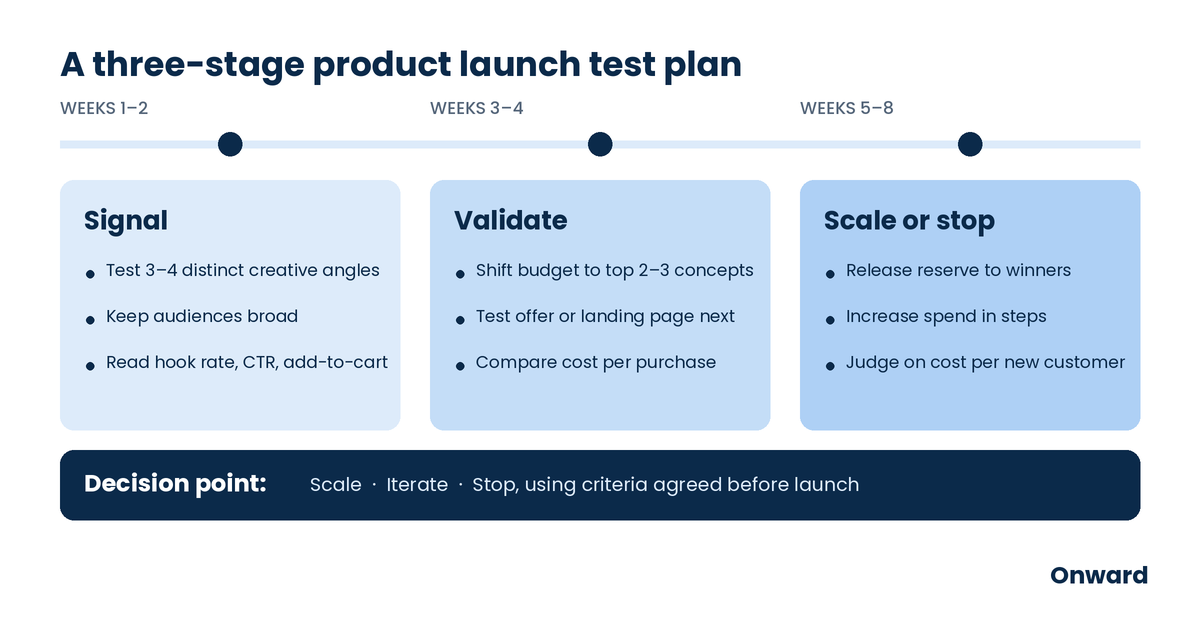
A staged plan keeps early noise from driving big decisions. The timing below is a starting point and should flex with budget and conversion volume.
Run several distinct creative concepts, each built around a different angle: the problem the product solves, a demonstration, social proof, or a comparison. Keep audiences broad so the test measures the message, not the targeting. Watch leading indicators such as hook rate, click-through rate, cost per click, and add-to-cart rate.
Shift budget to the two or three concepts with the strongest leading indicators and enough purchases to compare. Start testing the next variable: offer, landing page, or a second channel. A Meta creative testing case study like Porter's shows how structured tests, tagged and compared on qualified outcomes, can separate real winners from cheap clicks.
Release the reserve budget to concepts that meet the target cost per new customer, and increase spend in steps while watching whether efficiency holds. Concepts that never reached target get cut.
The channel mix depends on whether people already search for the product. A new product in a new category usually has little search demand, so paid social does most of the discovery work. A new version of a familiar product can capture existing demand on search and shopping ads from day one.
Leading indicators tell you which creative is working before purchases pile up. Lagging indicators tell you whether the launch is a good business.
Reading these together requires ad data, order data, and product costs in one view, which is where full-funnel measurement and dashboards earn their keep.
Decide the rules before launch, and make the call when a pre-set spend or conversion threshold is reached, not on a fixed calendar date or a bad Tuesday. A simple framework:
Write the criteria down and share them with finance and merchandising. That turns "when to call it" into a shared decision rather than a debate, and it fits into a data-driven marketing efficiency cadence after launch.
Onward plans launches from the product's own economics. The team sets break-even and target CPA from SKU-level margin, structures creative tests so each concept gets enough data, and tracks results through to cost per new customer and contribution margin. For an example of profit-first acquisition in DTC apparel, see the 500 LEVEL DTC growth case study.
A good launch is a planned experiment. Budget for enough conversions to learn, stage the test so early noise does not drive big decisions, measure on new-customer cost and margin, and agree on the scale, iterate, and stop rules before spend begins.
If you are planning a launch and want a second set of eyes on the budget and test plan, talk to Onward's team.