



© 2025 Onward. All rights reserved.
Designed by BX Studio


A digital marketing agency contract should spell out exactly what the agency will do, how it gets paid, how either side can end the relationship, and who owns the ad accounts, data, and creative. It should also define how performance will be measured and how the agency hands everything back if you part ways. Most contract problems come from what the agreement leaves vague, so the goal is to make every one of those points specific before you sign.
This article covers common business terms, not legal advice. Have your own counsel review any agreement before you sign it.
The scope section defines what you are paying for. A strong scope lists the channels the agency will manage (for example, Google, Meta, LinkedIn, or Amazon), the work included in each, and what is explicitly excluded. If you are hiring for flat-fee performance marketing, the scope should say whether creative production, landing pages, tracking setup, and reporting are part of that fee or billed separately.
Vague language such as "ongoing optimization" or "strategic support" makes it hard to hold anyone accountable. Ask for deliverables you can check: a launch plan, a testing roadmap, defined reporting, and a list of who does what.
The fee section should state the management fee, how it is calculated, when it is billed, and every cost outside that fee. Look for:
Fee models create incentives. Under a percentage-of-spend model, the agency earns more when you spend more, even if the extra spend is unprofitable. The breakdown of agency fees based on ad spend shows how that gap widens as budgets grow. A flat fee keeps the agency's income separate from your budget; Blueprint, for example, scaled ad spend 11x with no increase in Onward's fee, as covered in scaling ad spend 11x on a flat fee.
This section decides how long you are committed. Check four things: the initial term, whether it auto-renews, the notice period to cancel, and whether either side can terminate for convenience or only "for cause."
Long minimum terms with automatic renewal can lock you into an underperforming relationship. Shorter terms, such as month-to-month agreements with a 30-day notice period, put the burden on the agency to keep earning the work. If an agency insists on a long commitment, ask what you get in return, such as a lower fee or a defined ramp-up plan, and what happens if agreed milestones are missed.
You should own your ad accounts, pixels and conversion tags, analytics properties, and any creative you paid for. The agency should work inside accounts you control, with admin access granted to them, not the other way around.
This clause matters most when a relationship ends. If the agency owns the Google Ads or Meta account, you can lose campaign history, audiences, and learning that took months to build. The contract should also say who owns custom audiences, landing pages, and creative files, and whether licensed assets like stock images or music can be reused after the engagement.
The contract should define how success will be measured, how often you will get reports, and who owns the data and dashboards. Two details are easy to miss.
First, metric definitions. If the agreement references "conversions" or "ROAS," specify whether those come from platform reporting or from your own backend revenue. Platform numbers can overstate results. Second, data ownership. If the agency builds a warehouse or dashboards, clarify whether you keep them. A client-owned marketing data warehouse means your reporting history stays with you if the agency changes.
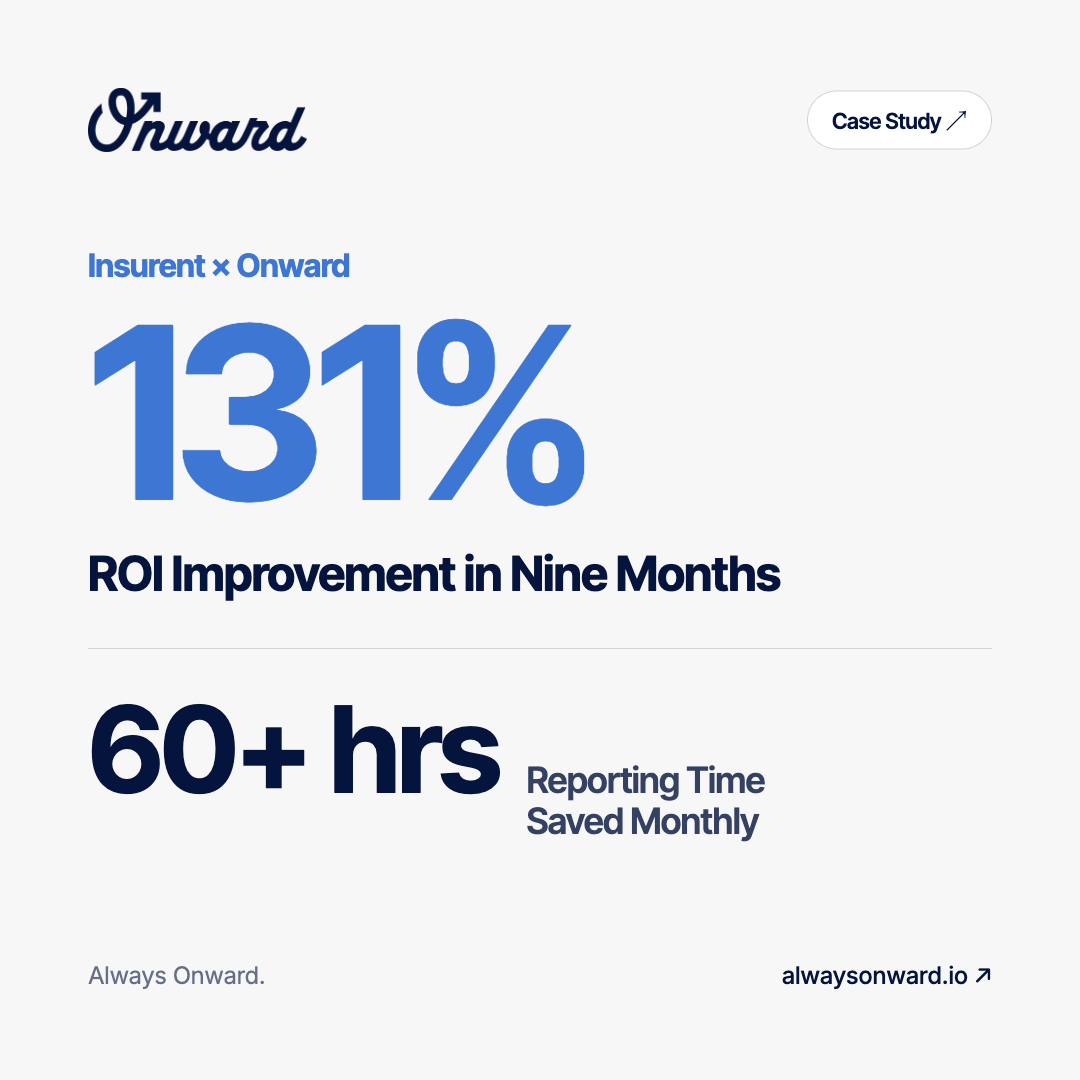
Good measurement terms also make results checkable. After Onward unified Google, LinkedIn, Meta, and Bing data in one warehouse, Insurent saw a 131% ROI improvement for Insurent in nine months and saved 60+ reporting hours each month.
Be cautious with contracts that guarantee specific rankings, ROAS, or lead volumes. Results depend on product, pricing, budget, and market conditions that no agency fully controls. A better clause defines the KPIs both sides will track, the baseline, and a review schedule where strategy gets adjusted if targets are missed.
The contract or statement of work should name the roles assigned to your account, the expected response time, and how often you will meet. Ask whether any work is subcontracted or offshored, and require notice if the lead strategist on your account changes. Many of these points line up with what to ask an agency before you sign, so use those answers to fill in the contract.

Your agency will see customer lists, sales data, and possibly personal information. The contract should cover confidentiality, how customer data is stored and deleted, and compliance with the privacy rules that apply to your business. Your legal team will know which requirements apply in your jurisdiction.
Finally, define offboarding: the agency's obligation to transfer access, files, reports, and documentation within a set number of days after termination. Planning for this upfront makes it much easier to manage how long it takes to switch agencies if you ever need to.
Onward is a performance marketing and growth marketing partner that combines paid search, paid social, and retail media with data infrastructure and engineered analytics. After a free discovery call, Onward sends a written proposal with a fixed monthly management fee. Engagements run on monthly contracts that can be canceled anytime, with $0 fees on ad spend and data and business reporting included in the ads service.

A good agency contract protects both sides by making expectations specific: what is included, what it costs, how results are measured, who owns what, and how the relationship ends. If a proposal is vague on any of those points, ask for it in writing before you sign.
If you want to compare your current agreement with how Onward structures engagements, book a discovery call.