

Growth Marketing
September 10, 2026

We Published 60 Articles to Win AI Visibility for a Client. <blue>Here's What Actually Happened.</blue>

Troy Diffenderfer
Troy Diffenderfer
Luxury villa in Las Catalinas, Costa Rica
Table of contents

Scale Smarter with

Connect your sources, clean your data, and watch performance marketing soar with a flat fee and zero drama. Get started with a discovery call

Most AEO content gets published into a black box. You publish, you hope, and six months later someone asks whether it worked, and you point at a rankings tool built for a different kind of search entirely. We wanted a real answer, so we tracked one client's program from the first article to the first booking.

Starting in late February, we published 60 AEO-focused articles for a luxury villa client in Costa Rica, each one built around a real question a guest asks before booking, not a keyword. Here is what happened, what it took to get there, and what we're testing next.

Key facts

  • Baseline AI visibility (Feb 9 – Mar 15) sat at 0.83%. By September 7 it had climbed to 12.86%, roughly a 15x increase.
  • Visibility is now spread across seven AI sources, Perplexity, ChatGPT, Gemini, Google AI Mode, Google AI Overview, Claude, and Grok, rather than concentrated in one.
  • The 60 articles now account for 34 to 43% of total site traffic.
  • One AI-sourced inquiry, through Perplexity, turned into a booking worth more than $100,000.
AI visibility tracking dashboard showing Villa Alberti presence by platform: AI Overviews 36.5%, Google AI Mode 36.9%, ChatGPT 51.2%, and Gemini 39.7%, each with position and sentiment scores.
Platform-level view: how often Villa Alberti appears in answers on each AI platform, with average position and sentiment, across 252 tracked responses. This is a per-platform presence rate, a different measure from the 12.86% overall visibility score, which spans all tracked prompts and all seven AI sources.

We started with prompts, not keywords

The usual SEO instinct is to start with a keyword list. We started with a prompt list instead: the actual questions a guest types into ChatGPT or Perplexity before booking a stay, from head-to-head property comparisons to "how many bedrooms do I need for a group of 15 to 20 people." We scored the client against every prompt weekly, then published against the gaps.

That distinction matters more than it sounds. A keyword ranks a page. A prompt gets answered, and the model either pulls from your content to answer it or it doesn't.

What actually happened

For the first several weeks, almost nothing moved. Across the baseline period we tracked, overall visibility sat at 0.83%, and most non-branded prompts, the kind with no company name in them, returned at 0%. New content does not get cited the day it's published. In this case, the gap between publishing and a measurable lift in citation was closer to four to six weeks than four to six days, largely tracking normal crawl and re-indexing cycles across the different AI platforms.

By September, overall visibility had climbed to 12.86%. The lift wasn't concentrated in one AI platform either. It showed up across Perplexity, ChatGPT, Gemini, Google AI Mode, Google AI Overview, Claude, and Grok, which mattered more to us than the headline number, since a single-platform win is easy to lose and a multi-platform one is not.

Prompt performance table listing tracked Costa Rica villa prompts with topic, funnel stage, mention rate, trend, position, and sentiment for Villa Alberti.
Prompt-level view: how often Villa Alberti is mentioned in answers to individual tracked prompts, with topic, funnel stage, trend, position, and sentiment. Each rate reflects a single prompt, so it will read higher or lower than the overall visibility score for the full prompt set.

The lead that mattered

On August 12, a prospective guest asked Perplexity where to stay near Las Catalinas. The model pointed them to a comparison article we had published back in May. That inquiry turned into a booking worth more than $100,000.
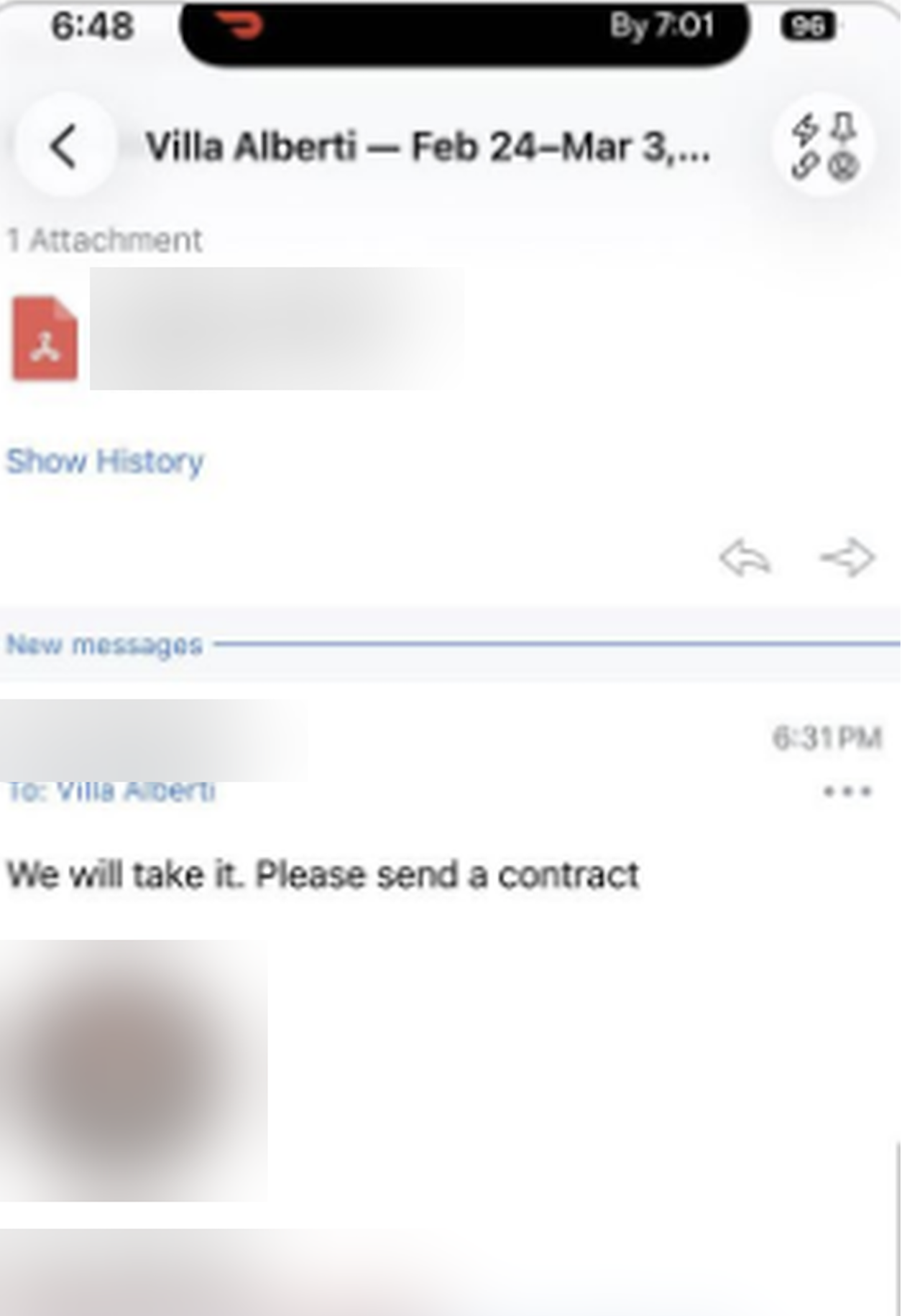
Screenshot of an email reply to Villa Alberti from a prospective guest reading: We will take it. Please send a contract.

We go deeper on this specific result, including the full baseline-to-current visibility data, in our case study: From Invisible in AI Answers to a $100K+ Booking.

What we learned

  • Non-branded prompts are the real test. Branded, head-to-head comparison prompts ("Client X vs. Competitor Y") moved fast and scored high almost immediately. Non-branded discovery prompts, the ones with no company name in them, took longer and are the ones that actually prove the content is working.
  • Distribution beats concentration. A visibility number driven by one platform is fragile. Ours held because it was earned across seven sources independently.
  • Comparison and use-case content outperformed generic guides. Articles built around a specific decision (this property vs. that one, this group size, this occasion) scored and converted better than broad destination guides covering the same general topic.
  • The gap between publish and citation is real. Budget four to six weeks before judging whether a new article moved the needle, not four to six days.

What's next

Three things, specifically:

  1. Continuing to target AEO prompt gaps with new content. The prompt-tracking approach that got us here doesn't stop once visibility improves. We're treating the prompt set as a living backlog, re-scoring it regularly and publishing against whatever still scores at or near zero.
  2. Implementing a connected MCP to create content at a quicker pace. Sixty articles in roughly six months proved the approach works. The next constraint is production speed, and we're building an MCP-connected workflow to shorten the loop between spotting a prompt gap and having a published, citable answer live.
  3. Starting Reddit outreach to improve LLM visibility and brand entity awareness. Several of the platforms we track pull heavily from forum and community content when building their answers. Establishing a real, credible presence in relevant Reddit communities is a different lever than on-site content, and one we think is underused in most AEO programs right now.

FAQ

What is AEO?

Answer Engine Optimization is the practice of structuring content so AI answer engines, ChatGPT, Perplexity, Gemini, and Google AI Overviews among them, can find, trust, and cite it directly in response to a user's question, rather than optimizing purely for a search-results ranking.

How long does it take to see AI visibility results?

In this program, the gap between publishing new content and a measurable lift in citation was roughly four to six weeks, tracking normal crawl and re-indexing cycles across the platforms measured.

Does it matter whether a prompt is branded or non-branded?

Yes. Branded, head-to-head comparison prompts tend to score high quickly, since the brand name is already in the question. Non-branded discovery prompts, the ones a real prospect would type without knowing your name, are the harder and more meaningful test of whether AEO content is working.

How do you measure AI visibility?

We track a fixed, weekly-scored set of booking-intent prompts across every major AI platform, then reconcile that visibility data against Google Analytics traffic and backend booking or revenue data, so a specific prompt can be traced to a specific page and a specific outcome.

Want a deeper walkthrough of how we structure content for this kind of program? Start with our AEO/GEO checklist, or see how Onward's answer engine optimization services can run this playbook for your own brand.