


© 2025 Onward. All rights reserved.
Designed by BX Studio


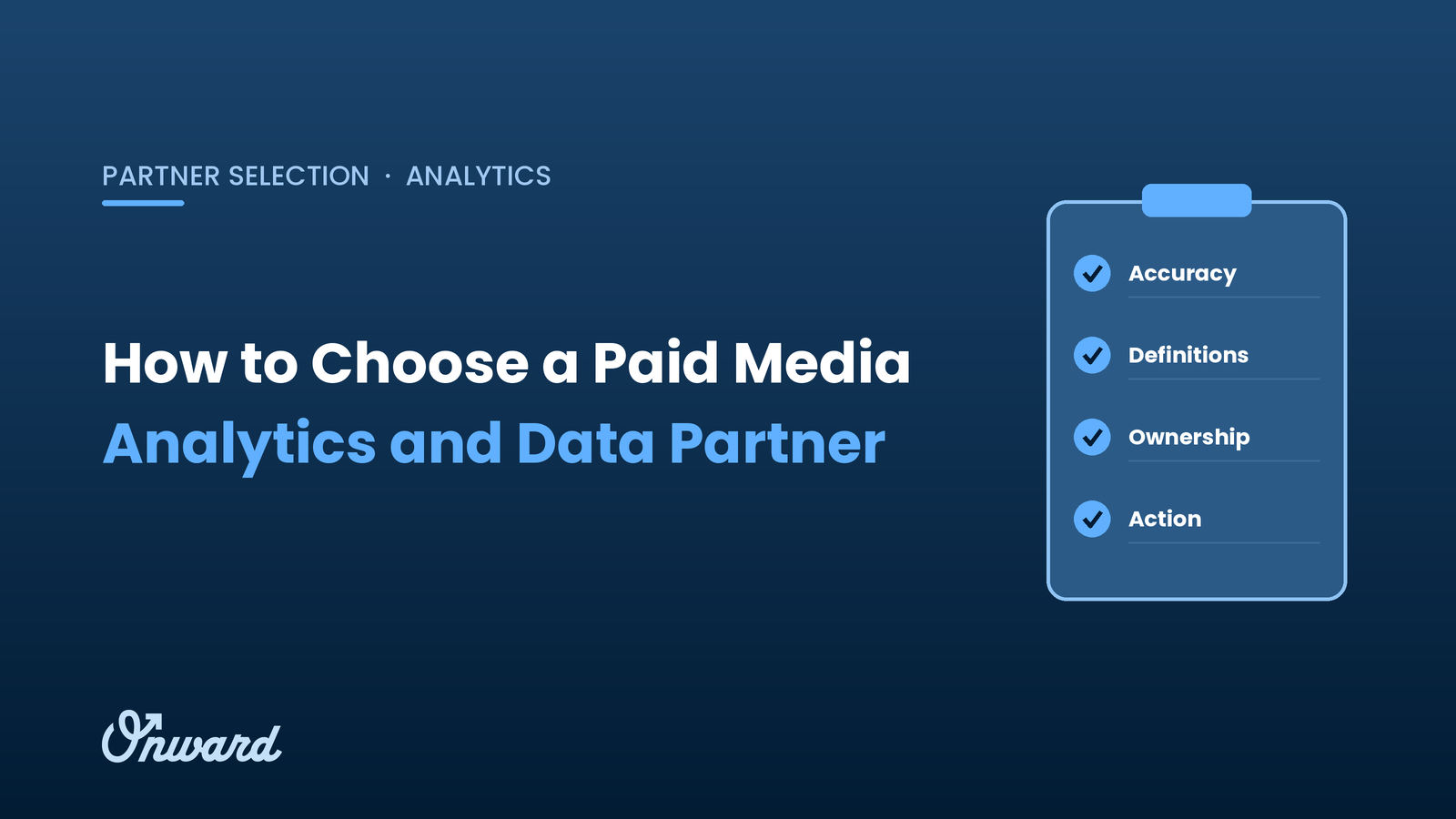
The right paid media analytics and data partner reports numbers that match your own revenue, defines metrics the way your finance team does, leaves you owning the data and dashboards, and helps turn what the data shows into budget decisions. Judge candidates on those four points before you look at dashboard designs or price. Then test the fit with a short audit or pilot built around your own data, not a demo account.
Key takeaways
A data partner for paid media connects ad platforms, analytics, ecommerce or CRM systems, and cost data, then turns them into reporting your team can use to decide where spend goes. The work usually includes tracking setup, data pipelines, a warehouse, metric logic, and dashboards. At Onward, that service is full-funnel measurement and dashboards built on a warehouse the client owns.
Companies offering this fall into a few groups. Dashboard and connector tools move data but leave the definitions to you. BI consultancies build excellent models but rarely touch media buying. Agencies that pair data engineers with media buyers sit in between, and the right choice depends on whether you have people in-house who can turn reports into decisions.
Accuracy is the first filter because every later decision depends on it. Ad platforms each count conversions by their own rules, so their totals tend to double-count and seldom agree with what your store, payment processor, or CRM recorded. A capable partner treats your backend system as the reference point and can explain every gap.
Ask each candidate how they reconcile platform-reported revenue with backend revenue, what match rate they consider acceptable, and how they handle refunds, returns, and cancelled orders. Then ask for an example. Songfinch, which sells personalized songs online, reconciles its marketing data with Stripe at better than 99%, which is the standard to hold a partner to.

Two dashboards can show different numbers for the same metric because they define it differently. Before anything is built, a good partner writes down how each metric is calculated and gets finance and marketing to agree.
The definitions that matter most for paid media:
Definitions should also cover timing. Decide which attribution window you use, whether revenue is counted on order date or payment date, and how late refunds are handled. A partner who skips this step will build attractive reports that nobody trusts in the first budget meeting.
Ownership is easy to overlook in a sales process and painful to fix later. If the warehouse sits in the partner's account, the dashboards live in their tool, or the transformation logic is a black box, leaving the partner means starting over.
Ownership also affects security: you should be able to remove the partner's access in minutes without breaking reporting. Ask where the warehouse will live, who holds admin access to every platform, whether you can see and keep the code or logic behind each metric, and what happens to historical data if you part ways. The case for a client-owned marketing data warehouse explains why this matters for paid media in particular.
Reporting only pays off when someone acts on it. A partner that delivers dashboards to a separate media agency creates a handoff, and handoffs slow everything down. A partner whose data engineers sit next to the people buying media can change budgets the same week a problem shows up.
Insurent, part of MRI Software, shows what that combination can produce. With its four ad platforms feeding one warehouse and media run against it, Insurent improved ROI 131% in nine months, as described in the B2B attribution and ROI case study. Onward's Google and Meta ads management is set up the same way, with media buyers and data engineers on one team.
Use the same short list with every candidate so answers are easy to compare:
For broader contract and pricing questions, the list of agency vetting questions covers the rest.
A tool is enough if you have someone in-house who can define metrics, maintain pipelines, and translate reports into media changes. If nobody owns that work today, a tool usually becomes another dashboard that does not match the others.
Once access and tracking are in place, Onward typically has first dashboards running within two to four weeks. Expect the first month to include fixing tracking and agreeing on definitions, which is time well spent.
Choose a paid media analytics and data partner on accuracy, shared definitions, ownership, and the ability to act, in that order. Test candidates against your own data before signing. To find out how closely your current numbers reconcile, schedule a free audit.