



© 2025 Onward. All rights reserved.
Designed by BX Studio


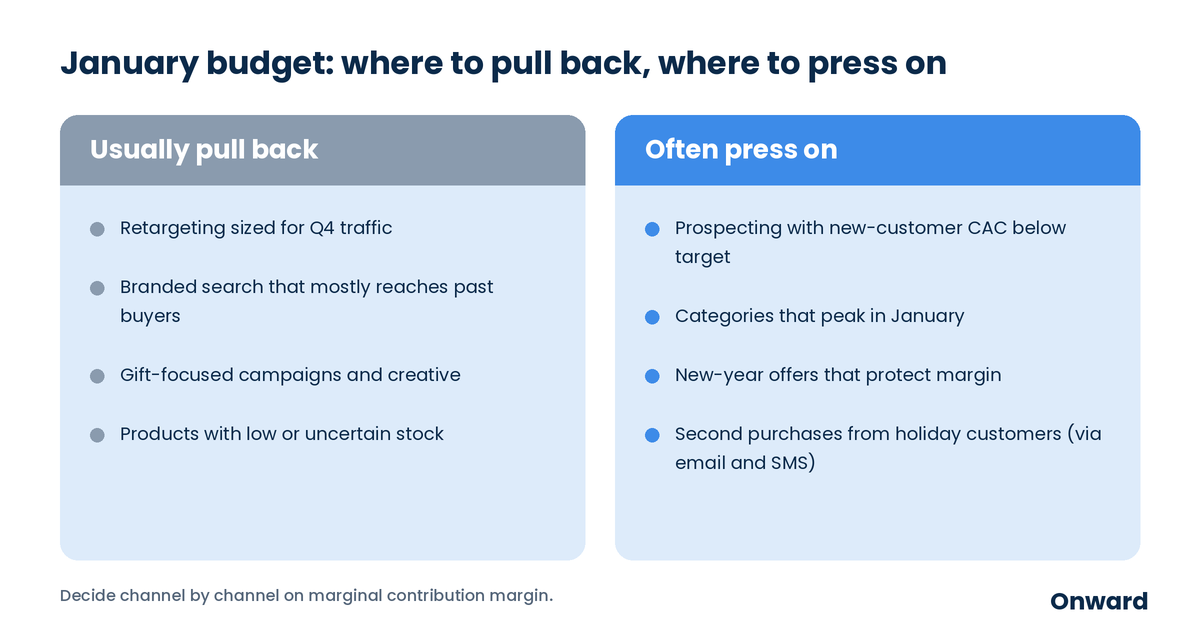
Don't cut January ad spend by reflex, and don't hold December budgets out of habit. Decide channel by channel, using what each extra dollar returned in contribution margin over the last two to three weeks. Auction competition usually eases once holiday advertisers pull back, which can make new customers cheaper. But January demand, order values, and returns also change, so the answer depends on your category, your cash position after Q4, and what your data shows about marginal returns.
Several things change at once after the holidays. Many advertisers cut budgets in January, which can lower auction prices. Shoppers' intent shifts away from gifts and toward resolutions, returns, and gift card spending. Retargeting pools are larger than usual because of Q4 traffic. And cash may be tight after inventory and media investment in November and December.
None of those effects points in one direction for every business. A fitness, wellness, or personal finance brand often sees January as a peak. A gift-driven brand may see demand fall sharply. That is why margin-focused paid media treats January as a set of channel-level decisions rather than one budget number.
Before setting January budgets, find out what Q4 actually earned. Platform-reported holiday revenue is the most generous version of the story. Returns, refunds, and chargebacks land in January, and discount depth during Black Friday and Cyber Monday reduces what each order contributed.
If you need a refresher on the inputs, start with the contribution margin formula. Apparel brands in particular should net out returns by style, because January is when holiday sizing mistakes come back.
Average performance hides the answer. What matters is the return on the last dollar spent in each channel. Compare weekly spend and new-customer CAC for the last two to three weeks of December and the first weeks of January.
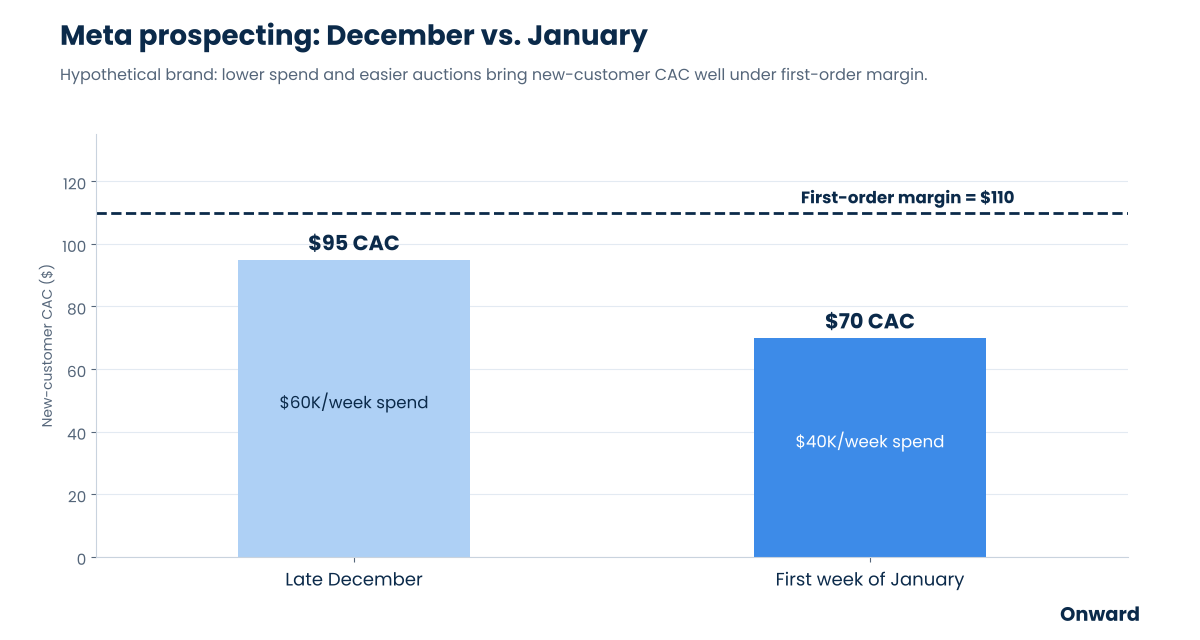
Hypothetical example: A brand spent $60,000 a week on Meta prospecting in December at a $95 new-customer CAC. In the first week of January, spend drops to $40,000 and CAC falls to $70, because CPMs ease and the audience is less crowded. Each new customer contributes $110 in first-order margin. December prospecting was barely profitable on the first order. January prospecting is clearly profitable, so this is a channel to press on, not cut.
Meanwhile, the same brand's retargeting reports a strong ROAS, but most conversions come from holiday buyers who already receive email. That spend is a candidate to cut.
Large, sudden budget changes can disrupt automated bidding while the platforms adjust. Move in steps and watch results weekly rather than switching everything off on January 2. Google's seasonality adjustments are designed for short events, typically a few days, so they are not a tool for a month-long shift in demand.
A weekly reallocation rhythm works well here. Review marginal CAC and contribution margin by channel each week, and move budget toward what is working. The approach to improving efficiency with CAC payback and LTV explains how to make that a standing process rather than a January scramble.
The holidays may have brought in thousands of first-time buyers. January is when they decide whether to come back. Lean on email and SMS to drive second purchases, rather than paying ad platforms to reacquire them. Second-order rates from holiday cohorts are one of the best early signals of how much those customers will be worth, and they should shape how hard you push acquisition in Q1.
All of this depends on seeing spend, orders, returns, and costs together, by channel and by new versus returning customer. Platform dashboards cannot do that on their own. The comparison of contribution margin vs. ROAS explains why a channel that looks strong in-platform can be the first one worth cutting.
Onward closes the holiday books on contribution margin after returns, then reallocates spend weekly toward channels where new-customer CAC beats target. That profit-first approach is the same one behind how 500 LEVEL grew revenue 156% while keeping paid acquisition tied to margin.
Often, because many advertisers reduce spend after the holidays, but not always and not in every category. Check your own accounts week by week rather than assuming a drop.
Pausing everything resets momentum and leaves you without data. A better approach is to cut the clearly unprofitable spend, keep prospecting that meets your CAC target, and adjust weekly.
Returns reduce the margin Q4 actually produced, which affects both cash and the CAC you can afford. Recalculate holiday performance after returns before committing to January spend.
Then plan for it like a peak season. Secure creative, inventory, and budget in December, and judge performance on new-customer CAC and contribution margin as the month unfolds.
The right January budget is not a percentage cut or a carryover. It is the set of channels where the next dollar still earns contribution margin. Close the holiday books, measure marginal returns, cut spend that reaches existing customers, and keep funding prospecting that pays back.
If you want a second opinion on your January plan, talk to Onward's team.