




© 2025 Onward. All rights reserved.
Designed by BX Studio


Beyond the management fee, a small business working with a marketing agency pays for ad spend, creative production, software and tracking tools, setup or onboarding work, landing page changes, and the time its own team spends managing the relationship. Ad spend is almost always the largest of these costs, and the management fee is often one of the smallest.
Below is each cost line, how to add them into one fully loaded number, and what to ask before you sign.
Most agency engagements create six cost lines on top of the management fee, plus contract minimums that decide how long you pay before you can change course. Two agencies quoting the same fee can produce very different total bills depending on which of these they include.
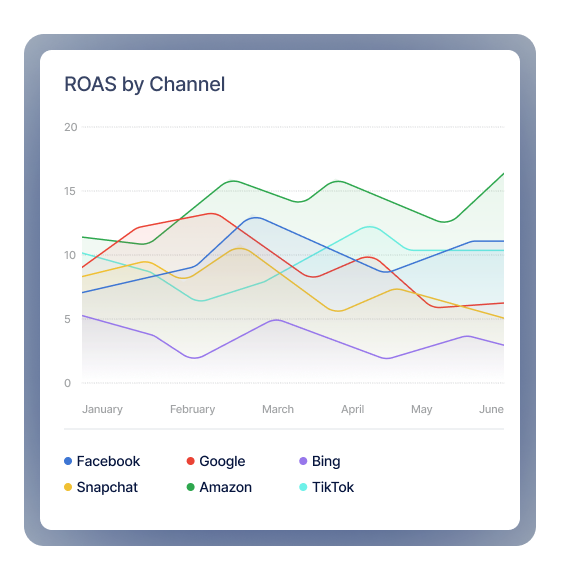
The most expensive hidden cost for many small businesses is optimizing to the wrong number. When an agency reports only platform ROAS, budget can keep flowing to campaigns that look efficient in Meta or Google but lose money after product cost, shipping, discounts, and returns.
Platform attribution is useful inside a channel, but it is not a financial system of record. Reporting built around optimizing paid media to contribution margin is what exposes those losses.
The fee structure decides whether management cost stays fixed or scales with your budget. As of September 2026, WebFX reports that paid media management fees typically run 10% to 20% of ad spend, or about $1,000 to $3,000 per month (WebFX PPC pricing).
At $10,000 a month in ad spend, a 15% fee is $1,500. At $40,000, it is $6,000, even if the work did not quadruple. A flat fee stays the same unless scope changes. The incentive difference is covered in more depth in agency fees based on ad spend.
Add every cost line into one monthly number, then divide it by new customers counted in your backend systems, not in the ad platforms. That gives you fully loaded customer acquisition cost (CAC).
Fully loaded CAC = (Fee + Ad spend + Creative + Tools + Amortized setup + Internal time) ÷ New customers from backend data
Hypothetical example, for illustration only: a store pays a $3,000 flat fee and $10,000 in ad spend, plus $1,500 for creative, $400 for tools, a $2,000 setup fee spread over six months ($333), and 10 hours of internal time valued at $50 an hour ($500).
If each new customer contributes less than $105 in margin, the program loses money however reasonable the fee looks.
Onward does not charge a percentage of ad spend. Each engagement is scoped to ad spend, number of channels, and campaign complexity, and after a free discovery call Onward sends a written proposal with a fixed monthly management fee. Data reporting is included in the ads service, and initial dashboards typically go live in two to four weeks, according to Onward's frequently asked questions about Onward.
Because Onward's unified marketing data connects ad spend with CRM and transaction data, teams can see fully loaded CAC and contribution margin by campaign instead of paying separately for tools to stitch those numbers together.
The management fee is the easiest cost to compare and the least complete. Add every line, measure new customers in your own systems, and judge the agency on fully loaded CAC and contribution margin.
To see what your current setup really costs, schedule a free audit with Onward and compare your ad spend against backend revenue and margin.


.svg)
