

© 2025 Onward. All rights reserved.
Designed by BX Studio


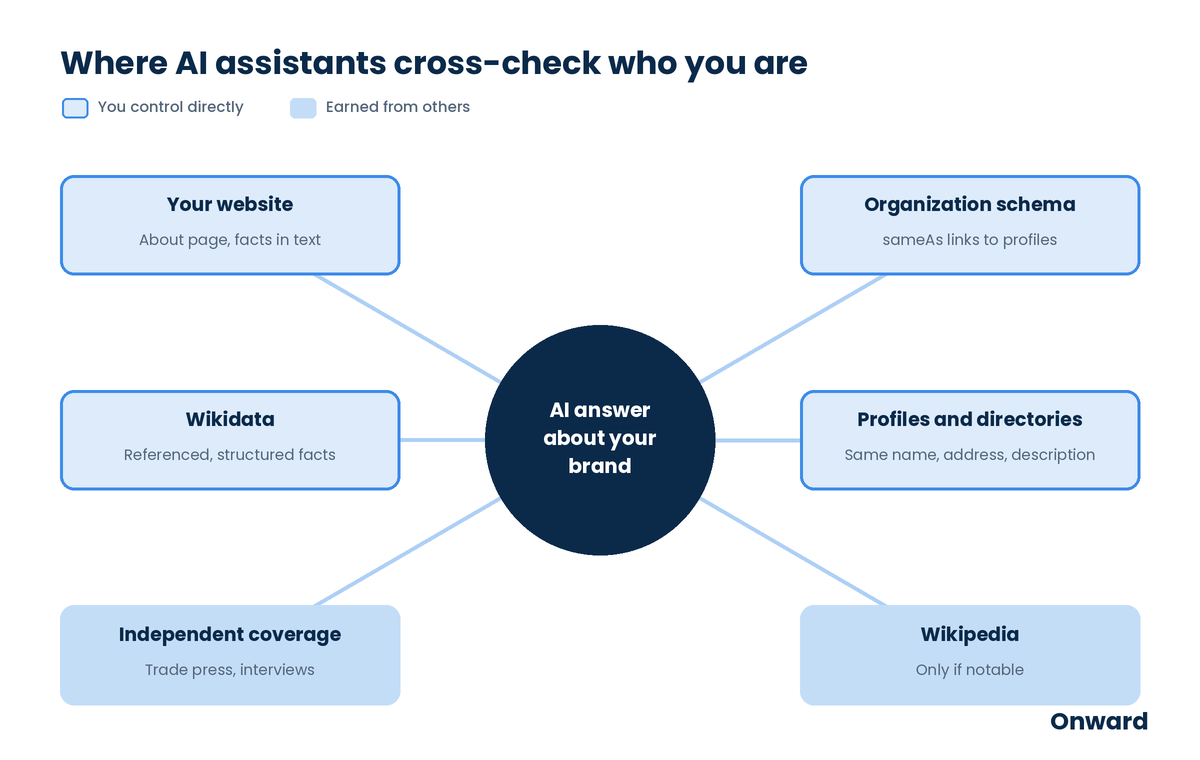
ChatGPT and other AI assistants learn who your company is from two places: what was in their training data, and what they find on the web when they answer a question. In both cases, they lean on sources that state facts clearly and are corroborated elsewhere, such as Wikipedia, Wikidata, your own website, and independent coverage. Most companies will not qualify for a Wikipedia article, and that is fine. Entity presence is built by publishing the same accurate facts everywhere an AI system might look.
When someone asks ChatGPT, Gemini, or Perplexity about a company, the assistant has to solve two problems. First, which entity does the name refer to? Second, what is true about that entity? A company called "Summit" competes for its own name with mountains, conferences, and dozens of other businesses. The assistant resolves that ambiguity using context: the industry, the website, the founders, the location, and how often those details appear together across sources.
If those details are consistent, the assistant can connect them with confidence. If your website says you were founded in 2019, LinkedIn says 2020, and a directory lists an old address, the assistant has to pick, and it may pick wrong. That is the root of many incorrect AI answers about brands, and it is why AEO services for high-ticket brands start with entity consistency, not content volume.
Wikipedia is written to be factual, cited, and neutral, and it is reused widely. Wikimedia Enterprise, which sells Wikipedia data through APIs, describes its product as built for "populating knowledge graphs, grounding models in cited facts, and answering questions," and lists Amazon, Google, Microsoft, Meta, Perplexity, and Mistral AI among the companies it serves. Wikipedia content is also licensed for reuse, which makes it common in web-scale datasets.
Google's knowledge panel documentation says facts in its Knowledge Graph come from public sources, licensed data, and content owners. A strong presence across trusted public sources therefore helps more than one AI product at once.
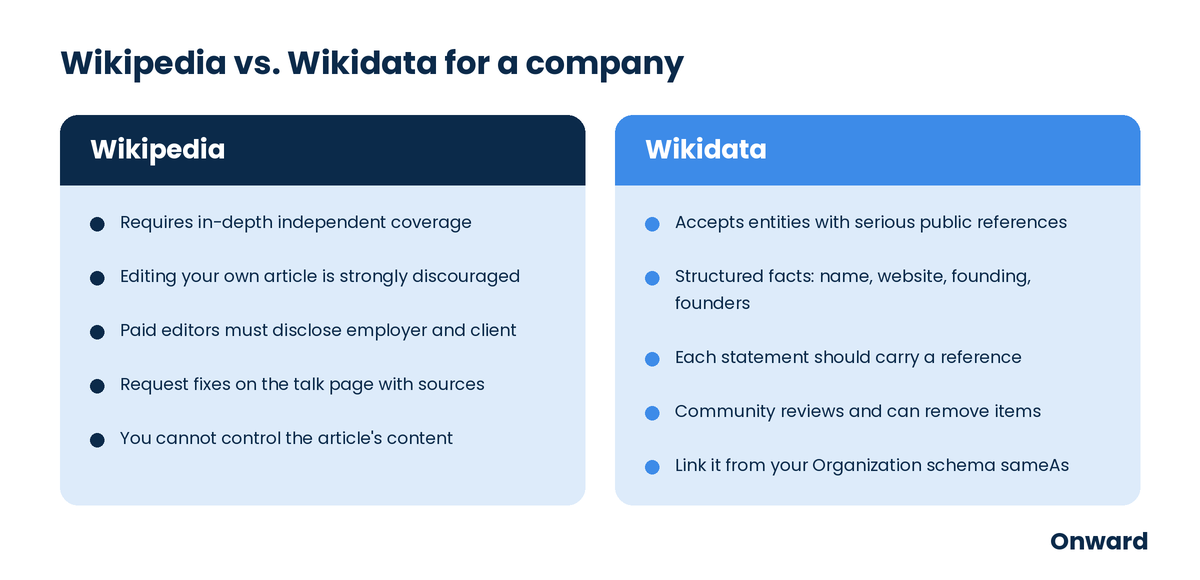
Only if independent, reliable sources have already written about it in depth. Wikipedia's notability guidelines for companies look for substantial coverage in independent publications, not press releases, paid placements, or your own website. A company that has not been covered that way will not qualify, however well the article is written.
The rules on writing about your own business are strict. Wikipedia's conflict of interest guideline says "COI editing is strongly discouraged" and that paid advocates "should instead propose changes on the talk page of the article in question." Under the Wikimedia Foundation's terms of use, anyone paid to edit must disclose their employer, client, and affiliation. The guideline also warns that once an article exists, "you have no right to control its content."
If an article already exists and contains errors, the right path is to request corrections on its talk page using the {{request edit}} template, with reliable sources attached. Paying someone to write or edit your article without disclosure breaks Wikimedia's terms and tends to end in deletion or a public warning on the page.
Wikidata is the structured database behind Wikipedia, and it is open to far more entities. Its notability policy accepts an item if it meets at least one of three criteria:
A real company with verifiable public records can often meet the second criterion. A good Wikidata item includes the official name, official website, founding date, headquarters, industry, and founders, each with a reference. The same conflict of interest caution applies: add accurate, referenced facts, avoid promotional language, and expect the community to review your edits.
Most of the entity signal comes from sources you own or can update.
Hypothetical example: A home goods brand called Harbor shares its name with a software company and a restaurant chain. AI assistants keep blending the three. The brand rewrites its About page with explicit facts, adds Organization schema linking to its LinkedIn and Wikidata item, corrects two directories that list a former address, and earns trade press coverage that names its founder and category. Over the following months, assistants stop mixing it up with the restaurant, because every source now repeats the same identifying details.
The 26-point AI search audit includes entity and schema checks, and the guide to combining SEO, AEO, and GEO explains how this work fits into organic strategy.
Onward treats entity consistency as part of technical AEO, alongside schema and AI crawler access, and measures the result with tracked prompts across AI platforms. That process is how a luxury villa won AI search visibility and turned it into $100K+ in booking revenue.
Paid editing must be disclosed under Wikimedia's terms, and articles about companies without independent coverage are usually deleted. Invest in earning coverage first. If your company becomes notable, an article can follow.
It helps, because it gives AI systems and knowledge graphs a structured, referenced record. It works best when your website, schema, and profiles state the same facts.
Assistants that search the web can reflect changes once the corrected pages are crawled. Answers drawn from training data change only when models are retrained, which can take months.
AI decides who your brand is by cross-checking sources. Make your own site the clearest statement of the facts, mirror those facts in schema, Wikidata, and profiles, and earn independent coverage. Wikipedia follows notability, not effort.
If AI assistants are getting your company wrong, talk to Onward's team.