


© 2025 Onward. All rights reserved.
Designed by BX Studio


To measure answer engine optimization (AEO) performance, track four links in one chain: whether AI platforms name you for the questions buyers ask, whether those answers send visits, whether those visits become leads or customers, and what those customers are worth after costs. The business case is the last link compared with the cost of the program. A rise in AI mentions with no path to revenue is a leading indicator, not a return.
AEO is harder to measure because there is no ranking position and no click report for most AI answers. An assistant like ChatGPT or Perplexity writes a fresh response each time, often names three to five options, and may never send a click. A buyer can read your name in an answer, search for you a day later, and arrive as "direct" or "branded organic" traffic.
That means AEO needs its own measurement design rather than borrowed SEO reports. Onward's AI search visibility services are built around this problem: tracking visibility, AI-referred traffic, and the customers that follow as separate but connected measures.
AI visibility is the share of tracked answers that name your brand for a written list of buyer questions. Build the prompt set from the questions buyers ask before choosing a provider, such as "best villa for a 20-person wedding in Costa Rica" or "which agency reports on contribution margin." Weight it toward prompts close to a purchase decision.
Run the same prompts on a schedule, weekly if possible, across several platforms. AI answers vary from run to run, so one screenshot is an anecdote, not data. What matters is the mention rate over time, which competitors appear in your place, and which websites the assistants cite as sources.
.png)
Break the rate out by platform as well. A brand can be named often by Perplexity and rarely by Google AI Overviews, and the fix for each is different.
.png)
Track AI referral traffic as its own channel in analytics, then accept that it will undercount. As of October 2026, OpenAI states that ChatGPT adds utm_source=chatgpt.com to referral links, and visits from tools such as Perplexity and Gemini typically appear as referrals from their domains. Group those sources into a single "AI assistants" channel so the trend is easy to read.
Google is different. Clicks from AI Overviews and AI Mode are counted inside the standard Web search totals in Search Console. In June 2026 Google began rolling out separate generative AI performance reports, initially to a limited group of sites and showing impressions but not clicks. For most sites, Google AI traffic still cannot be cleanly separated from organic search.
Two habits fill the gap. Add "AI assistant (ChatGPT, Perplexity, etc.)" as an option on every "How did you find us?" field, and watch branded search volume, which often rises when AI answers start naming you. Approaches to measuring LLM traffic go further into tagging and channel setup.
Connect AI visibility to customers by recording the source on every lead and order, then joining that data to your CRM, booking system, or ecommerce platform. The goal is a chain you can trace: prompt, then the page the assistant cited, then the visit, then the inquiry, then the closed sale.
Map each piece of AEO content to the prompt it targets. When a page starts appearing in answers and AI-referred leads land on it, the connection is visible instead of assumed.
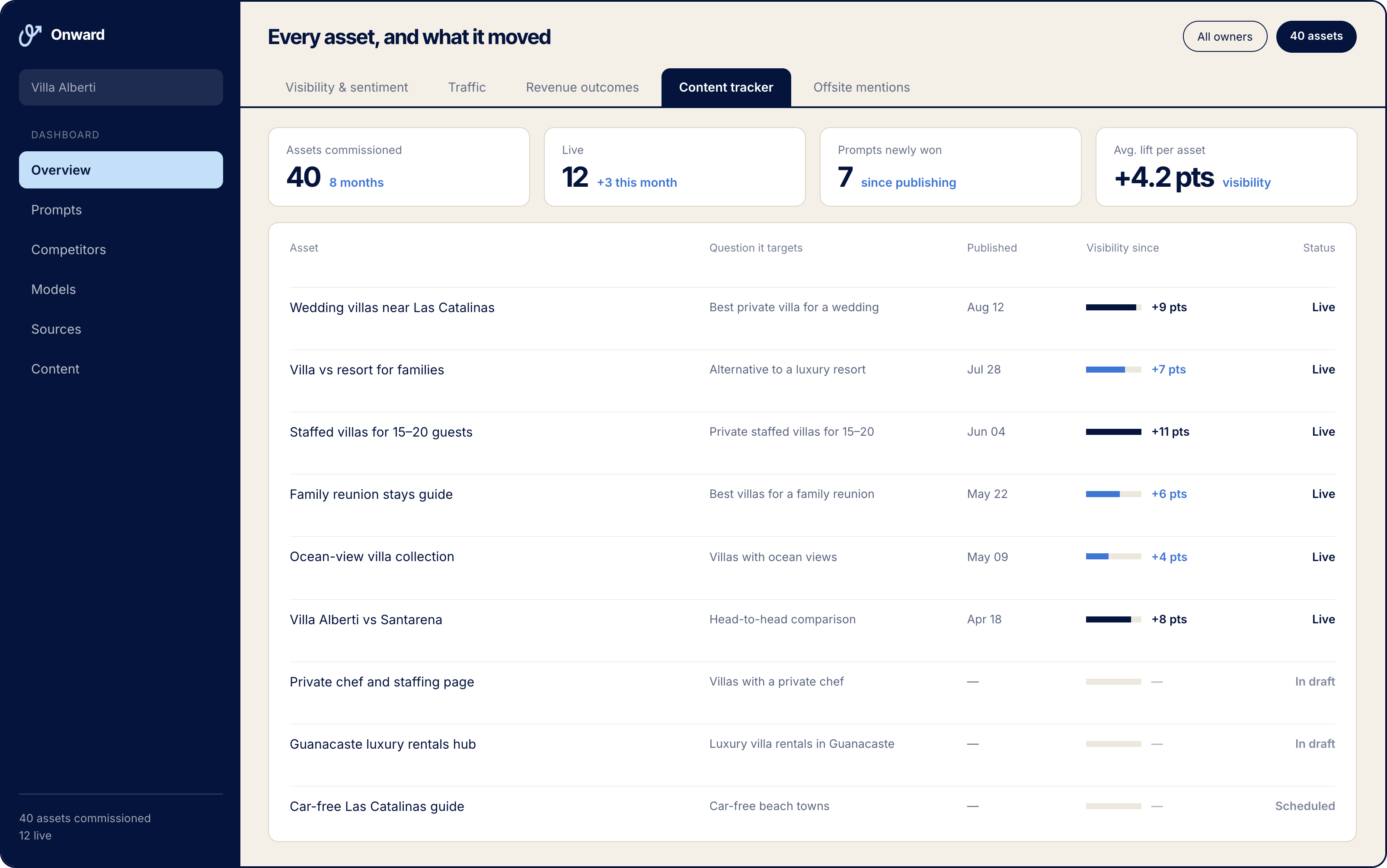
This is where AEO measurement becomes a data problem. Analytics, form fills, CRM stages, and revenue usually sit in different tools, and unified marketing data is what lets a team see AI-sourced customers next to paid and organic ones on the same basis.
The business case for AEO compares the program's total cost with the contribution margin of the customers it produces over a stated time horizon. Use contribution margin rather than revenue, because a customer's value is what remains after the variable costs of serving them. The contribution margin formula shows which costs belong in that number.
Hypothetical example: a high-ticket service business spends $6,000 a month on AEO content and tracking, or $72,000 a year. Its average new customer produces $9,000 in contribution margin in the first year. The program breaks even at eight AI-sourced customers a year. If paid search currently acquires customers at $4,500 each, AEO matches that cost at 16 customers a year, and every page keeps working after it is paid for.
A credible business case also states:
Villa Alberti, a luxury villa in Costa Rica, is one measured example. Its overall AI visibility across a fixed set of booking-intent prompts rose from 0.83% during a February to March baseline to 12.86% on September 7, tracked weekly across seven AI platforms. A single guest who found the villa through a Perplexity answer booked more than $100,000, confirmed against the booking backend.
The full timeline, including how the booking was traced, is in Onward's Villa Alberti AEO case study. It reflects one property in one market and is not a guarantee of the same result elsewhere.
Visibility changes can show up within a few months of publishing, while customer and revenue results usually take longer. Review leading indicators each month, and evaluate the program on customers after two or three quarters.
Several AI visibility platforms run prompt sets across assistants and report mention rates. Choose one that tracks multiple platforms on a schedule and lets you export your history, then confirm the setup with an AEO/GEO checklist before relying on the numbers.
Sometimes, but measure it rather than assume it. Compare conversion rate and customer value for AI-referred visits against paid and organic visits in your own data.
AEO earns its budget the same way any channel does: by producing customers whose value exceeds the cost. Measure visibility as the leading signal, track AI referrals as their own channel, connect them to customers in your CRM, and write the business case around contribution margin and a clear review date. To get a baseline on your own buyer questions, schedule a free audit.


.svg)
