


© 2025 Onward. All rights reserved.
Designed by BX Studio


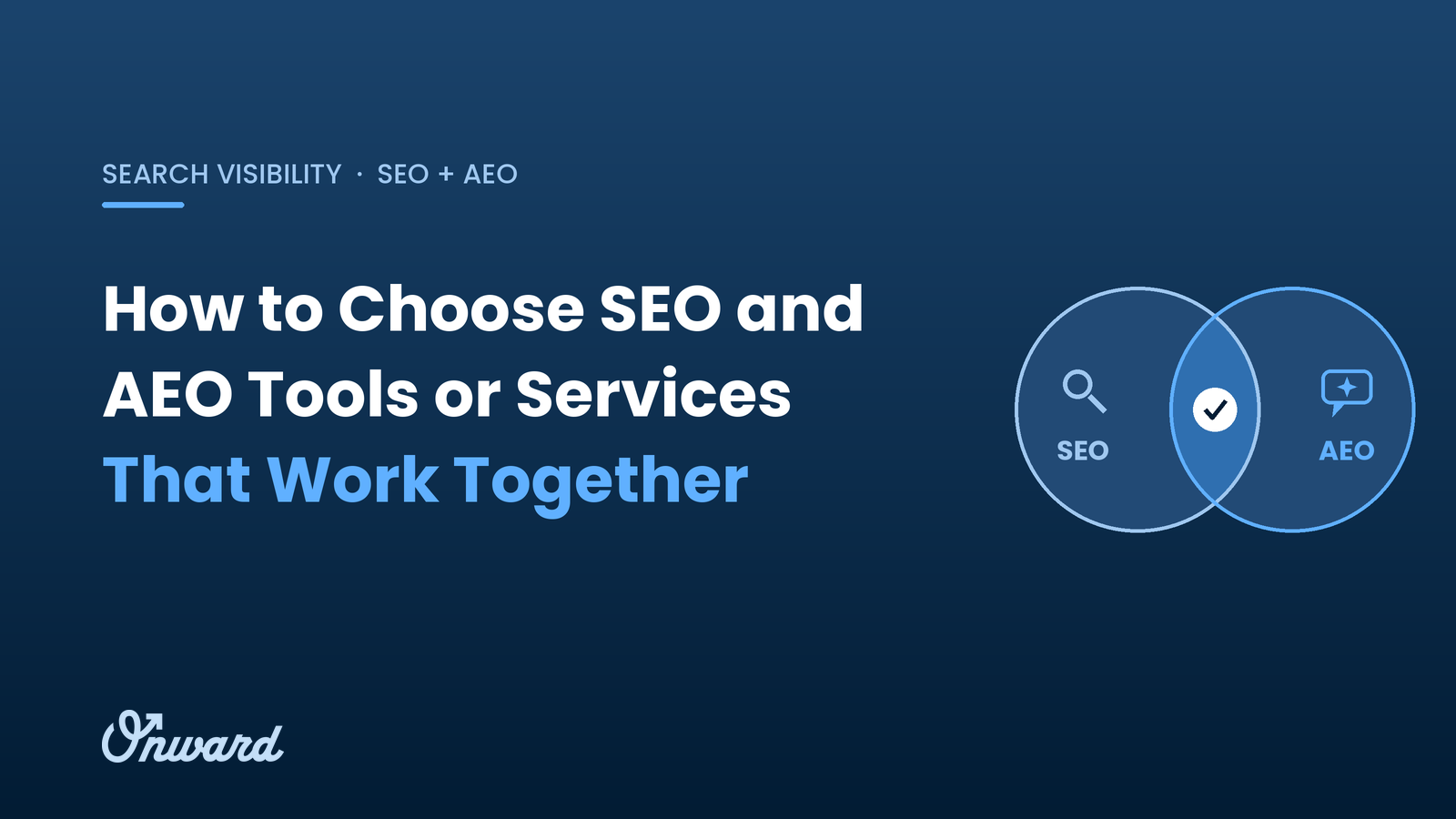
Choose SEO and AEO tools or services that share one map of your buyers' questions, measure results in leads and revenue rather than rankings alone, and report both traditional search and AI answers in the same view. If your SEO provider and your AEO provider work from different keyword lists, publish on separate calendars, and report in separate dashboards, you will pay twice for overlapping work and still not know what drives customers.
SEO and AEO work best together because they depend on the same assets. Search engine optimization earns rankings in Google results. Answer engine optimization (AEO), along with its close cousin generative engine optimization (GEO), earns mentions and citations when people ask ChatGPT, Perplexity, Gemini, or Google's AI features for a recommendation. Both draw on the same pages, the same technical foundation, and the same signals about who you are.
A page that answers a buyer's question clearly can earn a search ranking and an AI citation at the same time. A broken site structure or inconsistent business information hurts both. Splitting the two into unrelated efforts usually means duplicated content, conflicting priorities, and reports that cannot be compared. Onward's generative engine optimization services treat AI visibility as an extension of search, not a separate channel.
The two disciplines measure different things, and a good setup tracks both without confusing them.
AI answers vary from one run to the next, so a single screenshot proves little. Look for tools or services that run the same prompts repeatedly, on a schedule, across several platforms, and report visibility as a rate over time.

Use these six criteria to compare tools, agencies, or a mix of both.
The best setups start from a single list of buyer questions, grouped by intent, that drives both keyword targeting and AI prompt tracking. Ask how a provider builds that list and whether it comes from your sales conversations, search data, and customer language, or from a generic keyword tool alone.
Buyers use different assistants. Tracking only one platform gives a narrow picture. Onward's free AEO audit, for example, covers eight AI platforms, including ChatGPT and Google AI Mode, and ends with a tracked prompt set and your current standing.
Reporting without production leaves you with a list of problems. Ask whether the provider writes or updates pages based on what the tracking shows, and whether each new page is planned to rank and to be cited.
Schema markup, page speed, crawlable site structure, consistent business information across directories, and access for AI crawlers all support SEO and AEO at once. An AEO/GEO checklist is a useful way to see whether a provider covers these basics.
Rankings and mentions are leading indicators. The question that matters is whether they bring leads, bookings, or sales. Prefer providers who connect organic and AI-referred traffic to your CRM or sales data. The idea behind combining SEO, AEO, and GEO with clean analytics is that visibility should be judged by the customers it produces.
Ask whether you can export your prompt set, historical visibility, and ranking data if you change providers. Without it, you lose your baseline and start over.
The right mix depends on who will do the work.
Whichever you choose, avoid stacking separate SEO and AEO vendors who never talk to each other. Before signing, run through standard agency vetting questions to confirm who owns strategy, content, and reporting.
A short conversation reveals whether a tool or provider will actually connect the two disciplines. Ask:
Clear, specific answers are a good sign. Vague answers about "brand authority" or "algorithm updates" usually mean the work is not tied to outcomes.
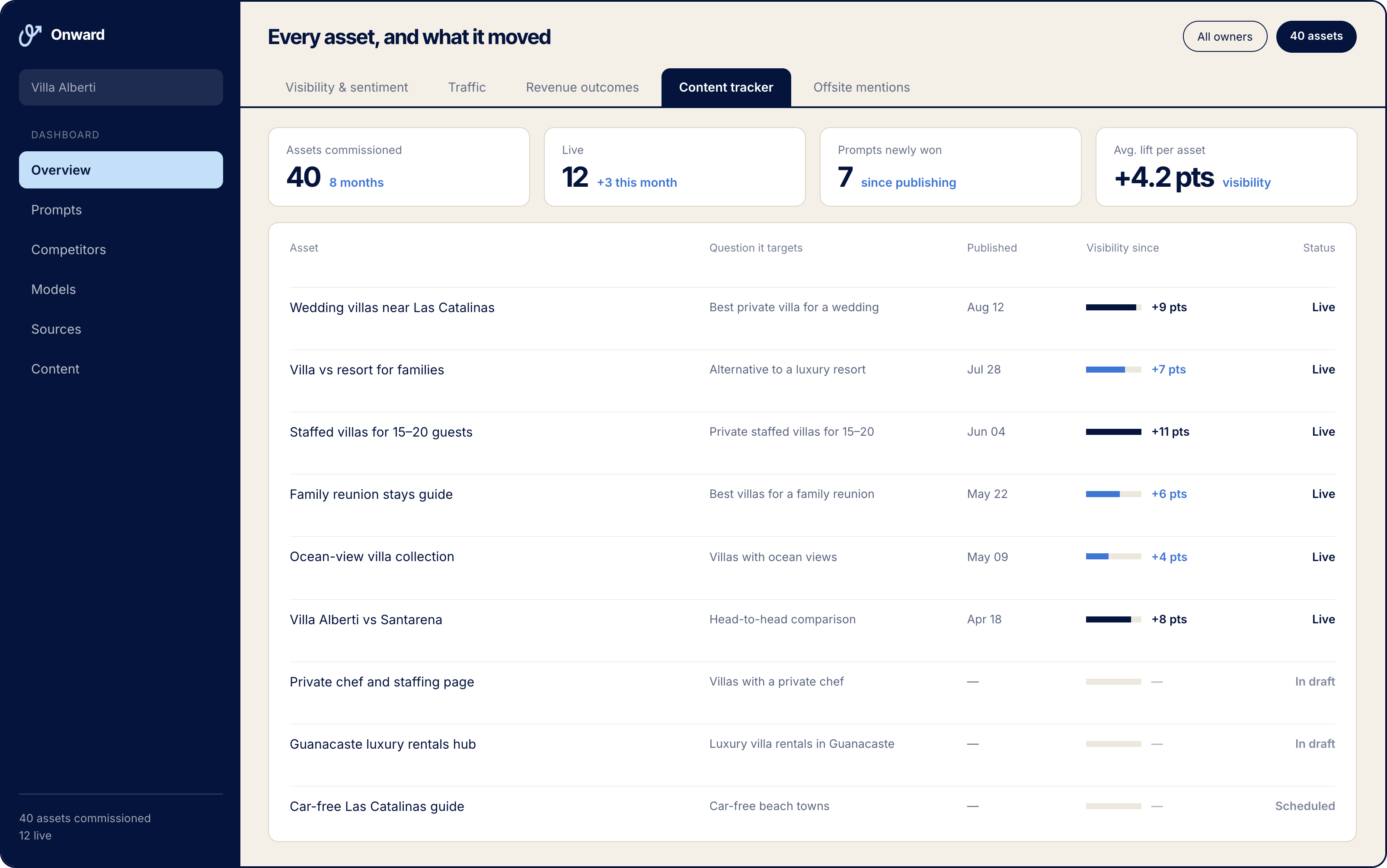
The luxury rental Villa Alberti tracks 58 booking-intent prompts every week across seven AI platforms, and 60 articles have been published around those questions. Its share of tracked AI answers grew from 0.83% in February to 12.86% by September, and the program has generated $100K+ in bookings from AI answers.
.png)
No. AEO relies on SEO fundamentals but adds prompt tracking, citation analysis, and content written to be quoted in AI answers. The measurement is different even when the underlying pages are the same.
Some platforms now report both, but coverage and methods vary. Check which AI platforms are tracked, how often prompts run, and whether results connect to your analytics.
Expect months, not weeks, for both. Track leading indicators monthly and judge the investment on leads and revenue over two or three quarters.
Pick SEO and AEO tools or services that start from the same buyer questions, share one technical foundation, and report on customers rather than rankings alone. If you want to see where your business stands today, schedule a free audit.


.svg)
